Ice Hockey
Defenceman
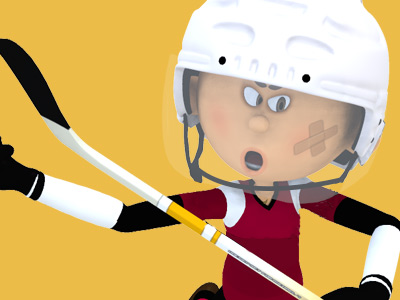
Defence or defense (in American English) in ice hockey is a player position that is primarily responsible for preventing the opposing team from scoring. They are often referred to as defencemen, D, D-men or blueliners (the last a reference to the blue line in ice hockey which represents the boundary of the offensive zone; defencemen generally position themselves along the line to keep the puck in the zone). They were once called cover-point.
In regular play, two defencemen complement three forwards and a goaltender on the ice. Exceptions include overtime during the regular season and when a team is short-handed (i.e. has been assessed a penalty), in which two defencemen are typically joined by only two forwards and a goaltender; when a team is on the power play (i.e. the opponent has been assessed a penalty), teams will often play only one defenceman, joined by four forwards and a goaltender. In the National Hockey League's regular season play in overtime, effective with the 2015–16 season, teams usually have only three position players and a goaltender on the ice, and may use either two forwards and one defenceman, or in rare cases – two defencemen and one forward.
'Stay-at-home' and 'Offensive' Defence
Defence players are often described by how much time they participate in offence. The extreme of non-participation in offence is a "stay-at-home" defender, who plays a conservative, risk-averse game and does not score much, instead focusing on defensive assignments towards the opposing team.
The other extreme of participation is an offensive defenceman, who gets aggressively involved in the team's offence. To accomplish this, the offensive defence player often "pinches in" to keep the play from going offside and moves towards the halfboards and high-slot area for scoring opportunities. This makes it difficult for the opposing team to protect their net from being scored upon if the team can maintain control of the puck. However, this can lead to more odd-man rushes and breakaway opportunities for the opposing team if the defender does not succeed. Bobby Orr's end-to-end rushing allowed him to defend effectively as well as attack, helping his teams win two Stanley Cup Championships. By contrast, Paul Coffey enjoyed high offensive production but his defensive play was considered mediocre for most of his career; he helped his teams win four Stanley Cup Championships, often paired with a "stay-at-home" defender.
Defensive Zone Play
When in the defensive zone, the defence player is responsible for keeping the opposing forwards' opportunities to a minimum when they are on a rush, forcing them to the corners and blocking both passing and shooting lanes. The primary responsibility is to cover areas of the defensive zone that would otherwise pose a clear goalscoring threat from the opposing offence.
When the opposing offence is putting pressure on the defence's team, the defence skater usually plays closer to the net, attempting again to block shooting lanes but also ensure that the goalie is not screened (prevented from being able to see the puck at all times). It is especially critical for the defenceman to keep opposing forwards from being able to move effectively in front of the net, which is why defencemen are frequently tasked with playing physical hockey in front of their own net. If a shot on net is made, an unguarded forward can often redirect it too quickly for the goalie to adjust or else score on a rebound. Another important duty is clearing rebounds away from the goal, and preferably to the defenceman's teammates, before opposing forwards can get to them. Often, defence players end up covering the opposing team's wingers while in the defensive zone, while their centre will cover the opposing team's centre.
Neutral Zone Play
In the neutral zone, the defence hangs back towards their own blue line, usually playing the puck up to other teammates. According to Jay Leach, who writes for NHL.com's "learn to play hockey" section, the defence must "Move the puck hard and quick to the open man. Join the rush, [but] do not lead it." Because of this responsibility, defencemen must read the other team's defensive strategy effectively in order to make an effective first pass that furthers the offensive momentum without leaving the defenceman out of position should his team lose control of the puck. In certain situations the best option could be to skate the puck into the zone to maintain offensive speed as well as preventing an offside.
Offensive Zone Play
In the offensive zone, the defence skaters usually "play the blue line". It is their duty to keep the puck in the offensive zone by stopping it from crossing the blue line that demarcates where the offensive zone begins. Should the puck cross this line, the offence cannot touch the puck in their opponent's zone without stopping play. Defencemen must be quick to pass the puck around, helping their forwards to open up shooting lanes, or taking open shots themselves when they become available. The defence must also be able to skate quickly to cut off any breakaways, moving themselves back into the defensive zone ahead of the onrushing opponent.
Essentially in all three zones of the rink, the defence is the backstop for the puck. It should never go behind the defence, unless the player intentionally lets it for strategic reasons. The defence keeps the momentum of play squarely directed towards the opposing goal, or at least away from his own.
Because defencemen are often expected to shoot on the opposing net from long range, these players often develop the hardest and most accurate slapshots. This is because taking a more stationary position on the blue line rewards pure accuracy and patience, rather than the adept hand–eye coordination attributed to forwards. Al MacInnis, who was seven times decorated with "Hardest Shot" in NHL skills competitions, was able to score frequently from the blue line because his slapshot was simply too fast to block effectively.
When a team is on a power play, a defence player can set up plays in the offensive zone, and distribute the puck to the teammate that he or she feels is in the best position to score, similar to a point guard in basketball, a playmaker in soccer, and a quarterback in American football and Canadian football. For this reason, a defenceman will often be described as the power play "quarterback", in particular if an umbrella power play formation is used (where a single defenceman is occupying the point, in the middle of the ice). This is also referred to as "playing the point" (this term derives not from the basketball position, but from an older name for the defence position in hockey itself).
Faceoffs
During faceoffs in the defensive zone, most teams have their defence players pair up with opposing wingers to tie them up while leaving his team's forwards open to move the puck, though this is at the discretion of the individual coach. In the offensive zone, the defence player acts in their usual role, keeping control of the puck as the forwards fight for position.
In the first organized ice hockey, defencemen used to line up in an "I" formation behind the rover (defunct) as point and cover point. Defence is still referred to as "playing the point", though this term now refers mostly to the role of defencemen on the power-play
Skating
Defencemen must possess excellent skating abilities, specifically in speed, constant foot movement and quick transitioning from forward to backward and vice versa. With regard to skating backwards, defencemen must acquire a higher skill level than offensive players. This allows them to face their offensive opponents as they rush down the ice toward the defensive zone. A defenceman must be as comfortable going backwards and sideways as forwards. Defencemen must also gain confidence in quickly carrying the puck to open up the attack during a defensive zone break-out. This requires the ability to burst out of the defensive zone with speed, yet at the same time having the ability to use their vision to execute quick passes to open forwards, or gaining the neutral zone before shooting the puck into the offensive zone.
SPORTS

RESOURCES
This article uses material from the Wikipedia articles "Ice Hockey", "Defenceman", which is released under the Creative Commons Attribution-Share-Alike License 3.0.
© Stories Preschool. All Rights Reserved.